
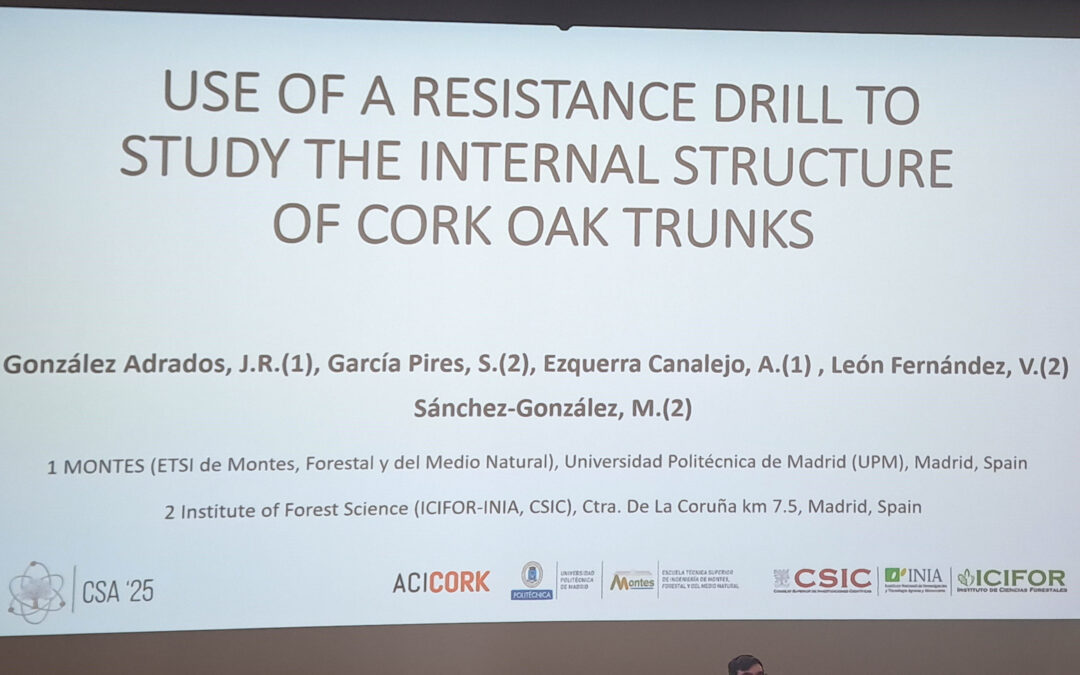
 Lisbon, 13 October 2025 – As part of the Cork Science and Applications 2025 (CSA25) conference, held from 13 to 15 October in Lisbon and jointly organised by the University of Aveiro and the University of Lisbon, an oral presentation entitled ‘Use of a resistance drill to study the internal structure of cork oak trunks’ was given as part of the Acicork project.
The presentation was given by José Ramón González Adrados, a researcher at the Escuela Técnica Superior de Ingeniería de Montes, Forestal y del Medio Natural, Universidad Politécnica de Madrid (UPM).
A new approach to measuring the thickness of cork oak bark
The study addresses a known limitation in the field of forest inventory and modelling: the inaccuracy of traditional methods for determining the thickness of cork oak bark (Quercus suber L.).
To overcome this problem, the researchers evaluated the use of a resistograph, a device that measures the resistance of the material to perforation, as a tool for obtaining accurate measurements of bark thickness, differentiating between the phloem (cork) and the phloem (mother layer).
The team used slices of cork oak logs from trees felled during thinning to generate strength profiles and compare them with measurements obtained through image analysis.
The results showed that the resistograph offers great potential as a non-destructive technique capable of providing detailed information on the internal structure of cork oak trunks.
According to the research team, this tool could contribute significantly to the development of more accurate models for predicting cork production and estimating biomass distribution in cork oak forests, thereby improving the sustainable management of these ecosystems.